The decline was significant because it came immediately after a strong rally. Investors who had benefited from the recent gains appear to have started booking profits, particularly as new risks emerged in the bond and commodity markets.
Oil Crosses the $100 Mark
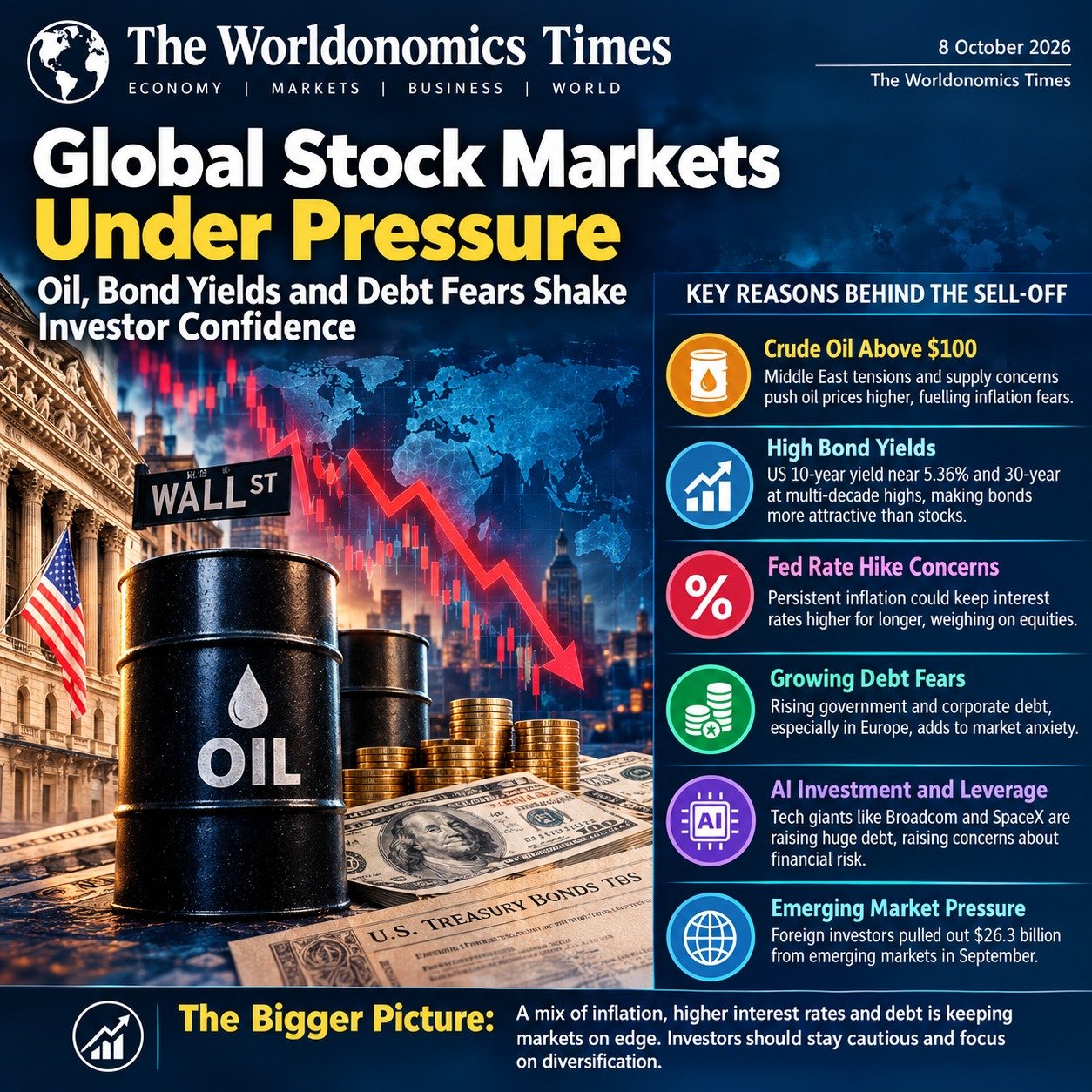
One of the biggest concerns for global investors is crude oil. Brent crude moved above the psychologically important $100 per barrel level and briefly reached around $102.
The increase is linked to continuing geopolitical tensions and concerns about disruption to oil supplies and shipping routes in the Middle East. The possibility of prolonged disruption has forced investors to reconsider the inflation outlook.
Higher oil prices can have a broad economic impact. Energy becomes more expensive for consumers and businesses, transportation costs increase and companies may face pressure on profit margins.
More importantly, expensive oil can make it harder for central banks to control inflation.
Bond Yields Become the New Market Problem
The second major factor behind the market weakness is the sharp rise in government bond yields.
The US 30-year Treasury yield touched a level not seen in approximately 24 years, while the 10-year Treasury yield moved close to its highest level since 2002. Rising yields indicate that investors are demanding greater returns to hold long-term government debt.
This creates a problem for equities.
When government bonds offer higher yields, investors have a more attractive alternative to stocks. At the same time, higher interest rates increase borrowing costs for companies and consumers.
The result can be lower corporate investment, weaker housing activity and pressure on stock valuations.
Inflation and the Federal Reserve
The combination of expensive oil and rising bond yields has brought the Federal Reserve back into the centre of investor attention.
Markets are worried that higher energy prices could keep inflation elevated and make it difficult for the Fed to ease monetary policy. The latest Fed minutes showed differing views among policymakers about the reasons for the recent rate increase and the need for additional tightening.
Investors therefore face an uncomfortable possibility: interest rates may remain high for longer than previously expected.
For equity markets, the equation is straightforward:
Higher inflation → Higher interest rates → Higher bond yields → Lower stock valuations
Global Debt Concerns Increase
Another important issue is the growing level of government and corporate debt.
Investors are increasingly concerned about the amount governments must borrow and the cost of servicing that debt when interest rates remain high. The pressure is visible not only in the United States but also in European bond markets.
UK 30-year government bond yields recently reached approximately 6.04%, their highest level since 1998, highlighting the scale of the global bond-market sell-off.
France is also facing fiscal and political pressures, adding another layer of uncertainty to European markets.
AI Investment Brings a New Risk
The artificial-intelligence boom, which has been one of the strongest drivers of global stock markets, is also becoming a source of concern.
Several major technology companies are seeking large amounts of debt to finance AI infrastructure and semiconductor purchases. Reuters reported that Broadcom is pursuing around $50 billion in financing, while SpaceX is planning around $30 billion in bonds and $10 billion in loans.
The concern is not that AI investment itself is negative. Rather, investors are questioning how much debt companies can accumulate to finance the massive infrastructure required for AI.
If borrowing costs remain high, highly leveraged companies could face greater financial pressure.
Emerging Markets Face Additional Pressure
Emerging markets are particularly sensitive to higher US Treasury yields and a stronger dollar.
Recent data showed that foreign investors withdrew approximately $26.3 billion from emerging-market stocks and bonds in September, as higher US yields and a stronger dollar reduced the attractiveness of emerging-market assets.
For countries such as India, higher crude prices are another concern because India imports a substantial portion of its crude oil requirements.
Higher oil prices can put pressure on India’s trade balance, inflation and the rupee.
What Investors Should Watch Next
The next few trading sessions will be important for global markets. Investors will closely monitor crude oil prices, US Treasury yields, central-bank commentary and developments in the Middle East.
If oil prices stabilise and bond yields decline, equity markets could regain some of their recent momentum. However, if oil remains above $100 and long-term yields continue rising, markets could experience further volatility.
The key question for investors is therefore not simply whether global stocks have fallen today. The bigger question is whether the current movement represents a short-term profit-booking exercise or the beginning of a broader repricing of risk.
For now, investors appear to be choosing caution.
The Worldonomics Times View
The current market weakness is best understood as a collision of three major forces: inflation, interest rates and debt.
Oil above $100 is increasing inflation fears. Rising bond yields are making borrowing more expensive. High government and corporate debt are increasing concerns about financial stability.
Until these pressures ease, global equity markets are likely to remain sensitive to every major movement in oil prices, bond yields and central-bank policy.