
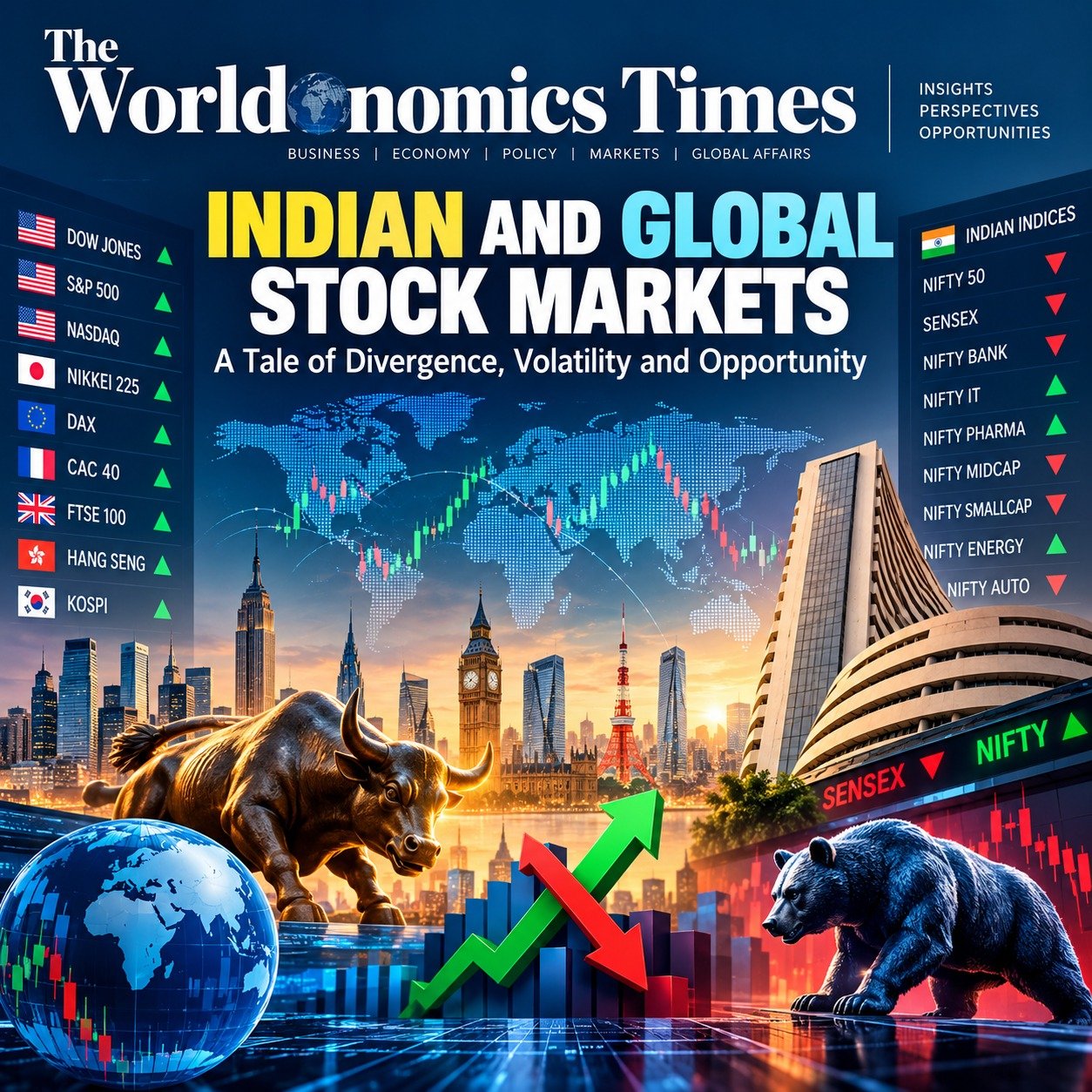
Indian and Global Stock Markets: A Tale of Divergence, Volatility and Opportunity
Global financial markets are entering a critical phase in 2026, with investors closely watching the interaction between geopolitical tensions, interest rates, commodity prices, corporate earnings and technology-led growth. For Indian investors, understanding both domestic and global indices has become increasingly important as international developments can quickly influence sentiment on Dalal Street.According to the latest market data, India’s benchmark indices have faced significant pressure this year. On October 14, 2026, the Nifty 50 closed at 22,622.70, down 0.44%, while the Sensex declined 0.34% to 72,781.89. Rising crude oil prices and continued foreign investor selling remained key concerns.
Global Markets Show a Mixed Picture
Global indices tell a very different story. Market performance across countries has diverged sharply in 2026. Recent comparative data shows Taiwan’s stock market among the strongest performers, while
South Korea and Japan have also delivered substantial gains. The Nasdaq has remained positive, whereas several European and emerging-market indices have experienced weaker performance. Investors can track major international benchmarks such as the Dow Jones, S&P 500, Nasdaq, Nikkei 225, Hang Seng, DAX, CAC 40, KOSPI and FTSE 100 through global index platforms. Groww’s global-indices dashboard provides information including index levels, daily movements, opening levels, highs, lows and previous closes.
The S&P 500, for example, remains one of the world’s most closely followed benchmarks and represents 500 major US companies across sectors. Similarly, Germany’s DAX provides an important indicator of European industrial and export-oriented businesses.
India Under Pressure
The Indian market’s relative underperformance has become one of the important themes of 2026. According to recent comparative data, the Nifty 50 has been among the weaker major global benchmarks this year.One major factor has been foreign portfolio investor selling. Reuters reported that foreign investors had recorded substantial year-to-date outflows, putting pressure on Indian equities. Higher US interest rates and global risk aversion have also made emerging-market assets less attractive. Crude oil has emerged as another important variable. With oil prices recently reaching around $106 per barrel amid geopolitical tensions around the Strait of Hormuz, India faces additional concerns because it is heavily dependent on imported energy. Higher crude prices can influence inflation, the rupee, corporate margins and the country’s trade balance.
Technology Provides a Different Story
Interestingly, the broader Indian market is not uniformly weak. Companies connected to the global artificial-intelligence infrastructure boom have performed strongly. Businesses involved in optical fibre, data centres, electricity, transmission equipment and related infrastructure are benefiting from rising global AI investment.This highlights an important lesson for investors: index performance does not always represent the performance of every sector or company. Groww’s Indian-indices platform allows investors to monitor a broad range of domestic benchmarks, including Nifty sectoral indices, Bankex, Midcap indices, Pharma, IT and other market segments.
What Should Investors Watch?
Going forward, investors should monitor five major indicators: US interest rates, crude oil prices, foreign portfolio flows, corporate earnings and global technology trends. The current environment reinforces the importance of diversification and a long-term investment approach. Market corrections can create opportunities, but valuations, earnings quality and business fundamentals remain critical.For investors, indices are more than numbers on a screen. They provide a real-time snapshot of economic expectations, investor confidence and global capital flows.
The Worldonomics Times View
In an increasingly interconnected financial world, Indian investors cannot look at the Sensex and Nifty in isolation. Tracking both Indian and global indices can provide valuable perspective on market direction, risks and emerging opportunities.Market data changes continuously. Investors should verify the latest index levels before making investment decisions.